




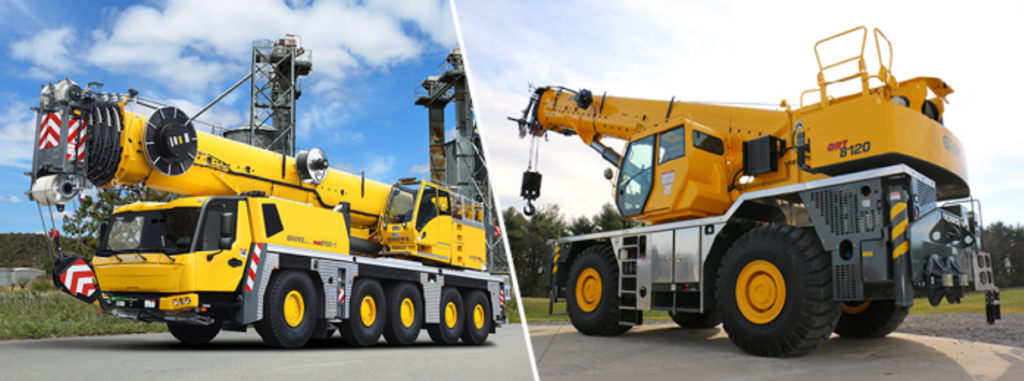
Every lifting project comes with its own set of requirements. Jobsite conditions, travel demands, available space, lifting capacity and reach can all influence which type of crane is best suited to the task.
For contractors and operators choosing between an all-terrain and rough-terrain crane, understanding the key differences can help ensure the right equipment is selected to maximise productivity, efficiency and lifting performance.
Grove offers both all-terrain and rough-terrain cranes designed to meet the demands of lifting operations across infrastructure, energy, industrial and commercial construction environments.
ALL-TERRAIN CRANES: MOBILITY MEETS LIFTING PERFORMANCE
Grove all-terrain cranes are designed for applications where mobility and lifting versatility are essential. Combining highway-speed travel capability with powerful lifting performance, they can travel directly between jobsites, enabling operators to undertake lifts at multiple locations without the need for separate transport equipment.
Their combination of road mobility, reach and lifting capacity makes them particularly well suited to projects where the crane needs to move regularly between locations while operating across a variety of terrain and jobsite conditions.
Grove all-terrain cranes are particularly suited to:
- Multiple jobsites in a single day
- Highway and road travel between projects
- Infrastructure and utility projects
- Large commercial construction
- Applications involving mixed terrain
For operations requiring a versatile crane capable of combining efficient road travel with substantial lifting capability, Grove’s all-terrain range provides a flexible solution.
ROUGH-TERRAIN CRANES: BUILT FOR DEMANDING JOBSITES
Where the work is concentrated on a dedicated site and conditions are more challenging, Grove rough-terrain cranes offer a different set of advantages.
Designed specifically for rugged off-road environments, rough-terrain cranes combine strong lifting performance with excellent manoeuvrability and stability. They are typically transported to the jobsite and remain there for longer-duration lifting operations rather than travelling regularly between sites.
Their compact design and off-road capabilities allow them to operate effectively across uneven ground and within confined working areas, making them well suited to demanding construction, energy and industrial environments.
Grove rough-terrain cranes are particularly suited to:
- Long-term lifting operations at a single jobsite
- Undeveloped and rugged sites
- Energy and industrial facilities
- Confined working areas
- Challenging ground conditions
MATCHING THE CRANE TO THE APPLICATION
Ultimately, the right crane depends on the demands of the lift. Where frequent road travel and movement between projects are priorities, an all-terrain crane can provide the required mobility and versatility. Where a crane will remain on a challenging site for an extended period, a rough-terrain crane may provide the manoeuvrability and off-road performance required.
By considering factors including travel requirements, terrain, available working space, lifting capacity and reach, operators can select the Grove crane best suited to the application – helping to deliver safer, more efficient and productive lifting operations.
GROVE CRANES FROM PATERSON SIMONS
Paterson Simons supplies and supports Grove cranes across West and Central Africa, helping customers select the right lifting equipment for their operational requirements. With extensive regional experience and technical expertise, our teams provide support throughout the equipment lifecycle, from crane selection and supply to commissioning, operator training, maintenance, parts and aftersales support.
Whether your application requires the road mobility and versatility of an all-terrain crane or the off-road capability of a rough-terrain crane, contact Paterson Simons to discuss the right Grove solution for your lifting requirements!
Image & info: Grove